The user problem
Homeowners spend months going through disconnected data in fragmented seller tools, unable to answer three fundamental questions:
Hypothesis
IF we build a personalized, AI-guided recommendation framework that surfaces the next best action at each stage,
THEN we will build decision confidence, increase user retention, and drive seller conversions in the Zillow ecosystem.
The business problem
Zillow’s standalone tools (Zestimate, Market Insights, Demand Discovery) generate high engagement but the business loses sellers at the moment of decision.
Zillow is a place people research selling, but not where they plan a sale.
Zillow is unable to bridge the gap between "thinking about selling" to "ready to sell."
THE "LIKELY SELLER" JOURNEY
The solution: Slice 1
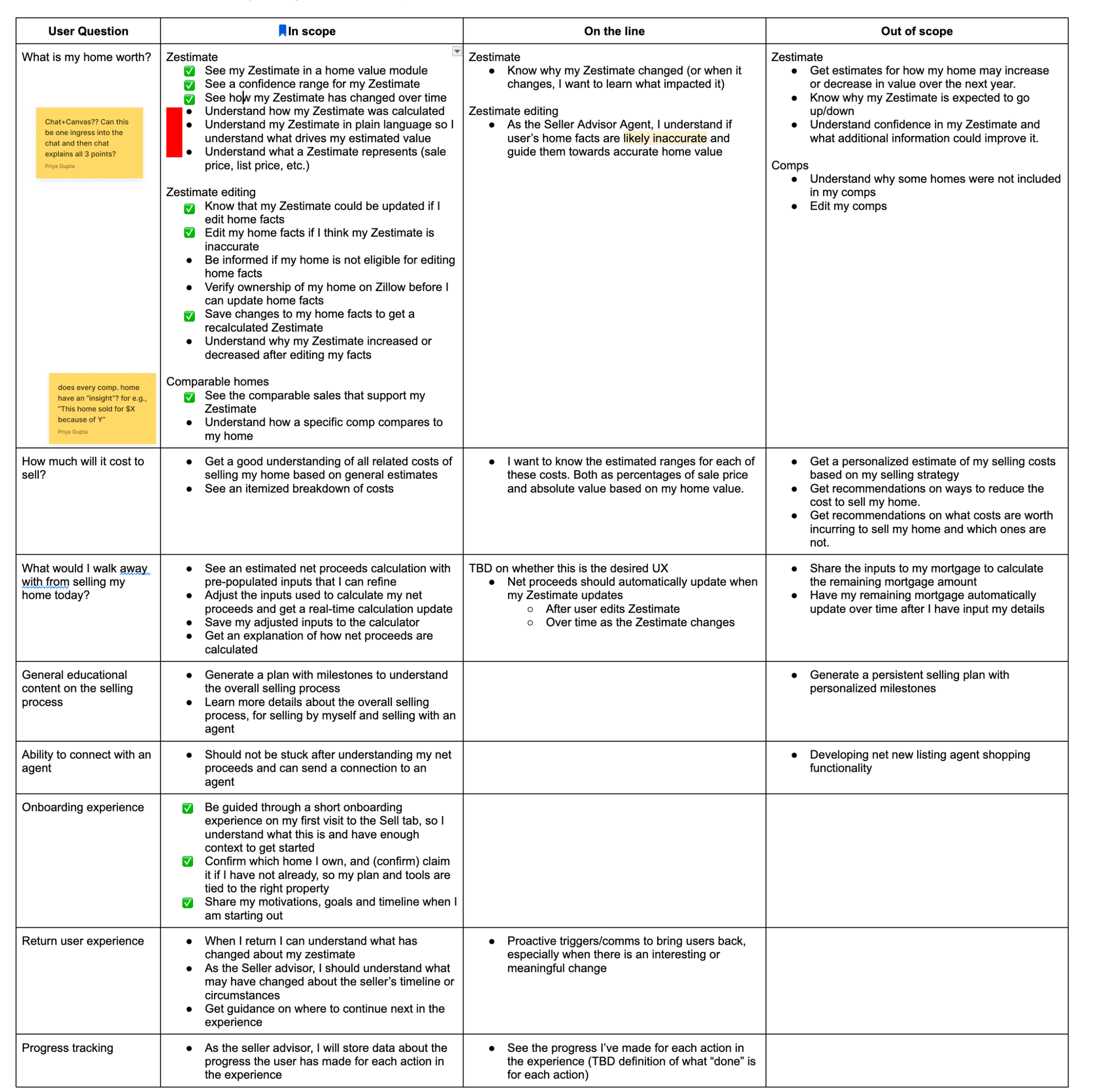
The 4-milestone journey was too broad for one release, so I partnered with PM and Engineering to scope Slice 1: Evaluate, tackling the biggest point of user churn while establishing the AI foundation for future phases. With pressure to ship, we prioritized what delivered real seller value over what simply looked good in a demo.
What a seller needs to do in order to get this job done
Completing these four actions moves a seller from Evaluate to Prepare to List. The AI agent's job is to guide them through this journey.
The finalized design direction
Much of the friction sellers feel is numerical. They receive Zestimate, comps, market trends, days on market, equity estimates, and closing costs but almost no explanation of what any of it means for their house at this moment. Making sense of numbers is left entirely to them. That is where AI does the real work here: not generating more data, but explaining the data already on the screen.
What this experience does
Anatomy of an action page
Every action page in the selling journey is built from the same seven parts. Home value is shown here with its canvas scrolled out.
AI Seller Advisor guides home fact updates via chat
The property records behind automated estimates are wrong more often than sellers expect. The Advisor collects corrections conversationally (beds, baths, finishes, condition), updating the estimate live as changes are confirmed.
AI Advisor guides editing and understanding net proceeds
Applying the ambient AI pattern to the single metric sellers care about most: take-home cash built up transparently from sale price, mortgage payoff, and closing costs.
Self-discovery and self-serve home facts editing. Advisor steps back
Empowering sellers who prefer direct control over conversational AI. Users can bypass chat overlays to edit property attributes directly on the canvas UI while the ambient advisor provides non-intrusive feedback in the background.
The process at a glance
{{ qDesc }}
The first artifact wasn’t a PRD; our PM built a functional prototype in Claude. The conversation started with something we could click.
Earns: a shared starting point in days, not a spec cycle.A workshop with the Plan tab team (sticky notes, clustering, dot voting) aimed at narrowing scope and naming the specific actions inside each milestone.
Earns: a shortlist to design against instead of a wishlist.Sixteen working hours to build both ends of the question: heavy AI guidance versus a plan the seller drives. Real inputs, real state.
Earns: two testable positions instead of one defended opinion.30 homeowners, three parameters, rated 1–5 with open follow-ups. Findings back in four days: 30/30 wanted net proceeds; 23/30 wanted structure over chat.
Earns: evidence that killed the AI-first direction cleanly.Rather than picking a winner, I combined the guidance of A, the structure of C, and the AI capability of B into an ambient model.
Earns: one direction with three sources of proof behind it.Negotiated autonomy inside the selling tab, 1 tap to value instead of 4, and phased the journey so Slice One ends at the decision point.
Earns: a shippable slice that still builds the whole system.Kickoff
Instead of starting with a static spec, our PM kicked off the initiative with an interactive Claude prototype
The first artifact was a functional prototype, not a PRD, that helped create immediate alignment across 12 partner teams.
How this fit into the system
Zillow’s recently-launched Plan Tab - a shared platform for buyers, renters, and sellers - required users to pass through three navigation layers before viewing actionable seller data. Research confirmed that deep navigation increased top-of-funnel drop-off.
The Plan tab's architecture required sellers to navigate through multiple screens before reaching anything actionable. Research told us sellers are already reluctant to commit; adding navigation depth would cause the same drop-off we were trying to fix. We negotiated with the Plan tab team: they keep their navigation, we get full autonomy within the selling tab. The broader IA challenge was scoped separately.
What I explored: How much should the AI do for the user?
Three of us on the seller design team built three deliberately divergent interaction models to feed the research study. The goal was to show leadership what was possible, and how AI could actually help a homeowner reach a decision and choose to sell with Zillow.
What we learned
I led an unmoderated study with 30 homeowners on Outset.AI resulted in a 33% / 33% / 33% vote split across all three prototypes
Position AI as the system's nervous system, not a sidebar widget. Ambient agent proactively guides users, self-invoking when users hit friction and stepping back when they self-serve.
What 30 sellers told us
"Right off the bat where it says you could walk away with X amount of money, that is a very important thing for me."
Participant #64
"I liked this one because it didn’t seem to force me to use the AI chat, but if I did want to use it, it was really easy to find."
Participant #87
What I took forward
What’s next
Engineering cycles have started, with a Q3 launch in sight. I was laid off before that ships, so the team carries it from here.